Summary
- Firecracker is a high-performance virtualization solution built to run Amazon’s serverless applications securely and with minimal resources. It now does so at immense scale.
Background
Virtualization
- Initially, a separate VM per Lambda customer, but existing VM solutions required significant resources, hence resulting in non-optimal utilization.
- 2 types of hypervisors
- Type 1
- directly integrated in the hardware
- Type 2
- run an operating system on top of the hardware, then run the hypervisor on top of that operating system
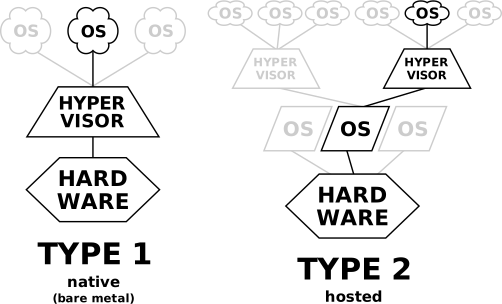
- Linux has a hypervisor built into the kernel - Kernel Virtual Machine, arguably a Type 1 hypervisor.
ols2007v1-pages-225-230.pdf
- virtio (linux provided interface) allows the user space kernel components to interact with the host OS. Rather than passing all interactions with a guest kernel directly to the host kernel, some functions (particularly, device interactions) go from a guest kernel to a virtual machine monitor (a.k.a VMM) (a popular example: QEMU)
bellard.pdf
Lambda
- When a lambda is invoked, the ensuing HTTP request hits an AWS Load Balancer.
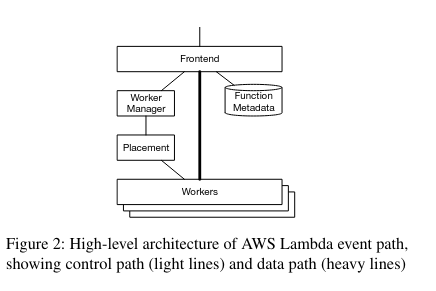
- 4 main components:
- Workers
- the component running lambda’s code
- each runs many MicroVMs in “slots” and other services schedule code to be run in the MicoVMs when a lambda is invoked
- Frontend
- entrance into the lambda system
- receives invoke requests and communicate with Worker Manager to determine where to run the lambda. then directly communicates with the Workers
- Worker Manager
- ensures that the same lambda is routed to the same set of Workers
- keep tracks of where a lambda has been scheduled previously
- Placement service
- makes scheduling decisions to assign a lambda invocation to a worker
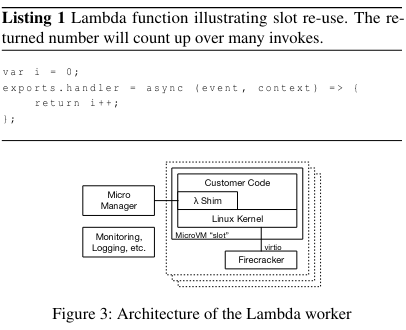
- Lambda Worker Architecture
- Firecracker VM
- Shim process
- process inside of the VM that communicates with an external side car called the Micro Manager
- Micro Manager
- a sidecar communicating over TCP with a Shim process
- reports metadata received back to the Placement service
- can be called from the Frontend to invoke a specific function
- on the function completion, receives the response from the shim process passing back to the client as needed
Interesting points
- Only IO performance was inferior, and they argue that causes are no flushing to disk and an implementation of block IOs which performs IO serially; async IO support with io_uring can resolve it, there is an issue about it in github.
[Perf] Implement async IO for the block device using io_uring · Issue #1600 · firecracker-microvm/firecracker
Lord of the io_uring
References